Navratri and the Psychology of Inner Strength: Who Are Today’s Demons?
The Durga Saptashati describes the Goddess as one who does not wait passively for evil to arise but steps forward with unwavering courage to confront it. One of its central ideas is that strength is not the absence of fear, but the decision to act despite it. This ancient symbolism mirrors a deeply relevant psychological truth: transformation begins when we acknowledge and face what disturbs us within.
PSYCHOLOGICAL
Dr Priyanka Gupta
3/23/20264 min read
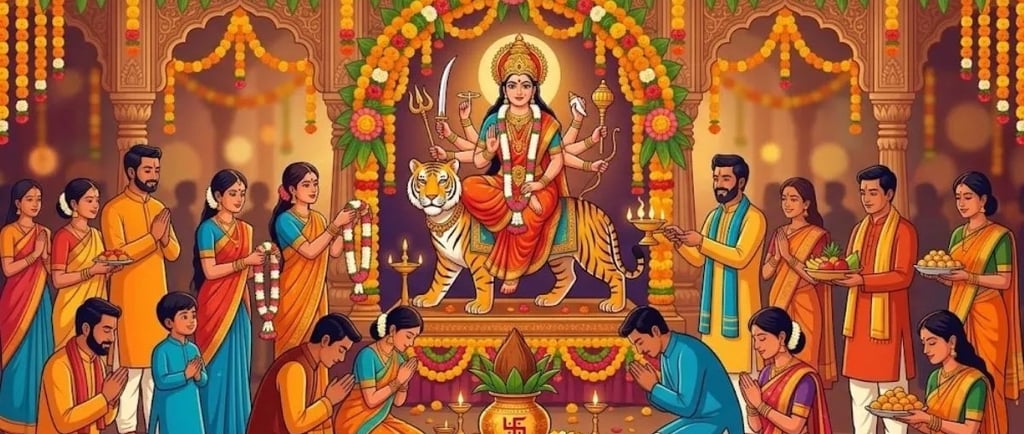
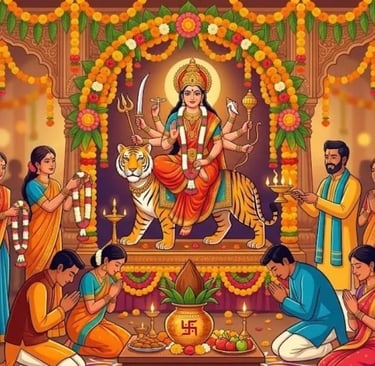
Every year, Navratri celebrates the victory of Goddess Durga over powerful demons. But in today’s world, the demons we fight are no longer external—they are psychological.
The Durga Saptashati describes the Goddess as one who does not wait passively for evil to arise but steps forward with unwavering courage to confront it. One of its central ideas is that strength is not the absence of fear, but the decision to act despite it. This ancient symbolism mirrors a deeply relevant psychological truth: transformation begins when we acknowledge and face what disturbs us within.
My earliest understanding of this did not come from theory, but from experience. As a child in Haridwar, living near the Ganges during Navratri, I once hesitantly joined a kanjak celebration. I remember walking into a stranger’s home with uncertainty, only to be welcomed with warmth, respect, and reverence. That moment—feet washed, a tika applied, and a simple meal shared—left a lasting imprint. For the first time, I felt valued simply for being a girl.
Yet, this stood in contrast to a quieter, unspoken feeling I had carried—that being a girl was somehow less desirable. That contradiction planted a question: if the feminine is worshipped as divine, why is it so often diminished in daily life?
This tension continues today, though in more subtle forms. Many women find themselves striving to “equal” men by adopting similar roles, behaviours, and even emotional patterns. But equality does not mean sameness. Psychologically, each individual—regardless of gender—carries both assertive (traditionally labelled masculine) and expressive (traditionally labelled feminine) qualities. The imbalance arises when one suppresses their natural inclinations in pursuit of external validation.
Modern research increasingly acknowledges that chronic emotional suppression, stress, and identity conflict can manifest physically. Conditions such as PCOS, fibroids, and other stress-related disorders are often discussed in relation to lifestyle and hormonal imbalance—but psychological stress and internal conflict also play a significant role in overall wellbeing. This does not imply simple causation, but it highlights the importance of mind–body integration.
In symbolic terms, the demons of today are anxiety, self-doubt, burnout, and the constant pressure to perform. Like the mythological Raktabija, whose blood created more demons each time it touched the ground, our negative thoughts multiply when repeatedly fed with attention. The more we dwell on fear and inadequacy, the more they grow.
The lesson from Navratri is not just about defeating these forces, but about how we do it. Durga does not deny the demon’s existence—she confronts it with clarity, discipline, and unwavering presence.
In practical terms, this translates into small but powerful shifts:
Creating space for self-expression through creative pursuits
Developing self-awareness instead of self-criticism
Balancing productivity with restoration
Cultivating inner stillness through practices like mindfulness or self hypnosis
True empowerment lies not in comparison, but in integration. The modern Durga is not someone who imitates strength, but someone who embodies it—through clarity, compassion, and courage.
Navratri, then, is not just a festival. It is an annual reminder that the battlefield is within, and so is the शक्ति—the strength—we seek.
What practical Pathways to Inner Balance we can imbibe daily: Reclaiming Expression and Healing
Creating space for self-expression is not a luxury—it is a psychological necessity. Engaging in creative hobbies such as painting, singing, dancing, pottery, macramé, writing, or crafting allows individuals to give form to their inner experiences. These activities act as non-verbal channels through which emotions, often suppressed in daily life, can be safely expressed and processed. In psychological terms, this enhances emotional regulation and reduces internal conflict.
Developing self-awareness, rather than falling into patterns of self-criticism, is another essential shift. When individuals begin to observe their thoughts without judgment, they move from a reactive state to a reflective one. This transition is associated with improved mental health outcomes, including reduced anxiety and better coping mechanisms.
Equally important is balancing productivity with restoration. In modern lifestyles, constant output is often prioritised over recovery. However, sustained psychological and physiological wellbeing depends on cycles of effort and rest. Incorporating pauses, leisure, and mindful disengagement supports cognitive clarity and emotional stability.
Cultivating inner stillness through practices such as mindfulness, relaxation techniques, or self-hypnosis further strengthens this balance. These approaches help regulate the nervous system, lower stress responses, and enhance overall resilience.
Emerging research in health psychology and psychosomatic medicine suggests that chronic stress and emotional suppression can influence physical health, particularly in conditions related to hormonal and reproductive functioning. While such conditions—including menstrual irregularities or fibroid-related symptoms—are multifactorial and require appropriate medical care, psychological wellbeing plays a supportive role in recovery. Positive lifestyle changes, emotional expression, and stress reduction have been associated with improved treatment responsiveness and overall wellbeing. These shifts do not replace medical care but can complement treatment and help the body respond more effectively.
Drawing from extensive clinical and experiential observations in therapeutic settings, it is evident that small, consistent shifts in daily behaviour—such as engaging in creative expression, practicing self-awareness, and allowing mental rest—can significantly enhance an individual’s capacity to recover and adapt. These changes create an internal environment that supports healing and allows medical interventions to work more efficiently.
Ultimately, these practices reconnect individuals with their inherent sense of balance, creativity, and resilience—allowing not only recovery, but renewal.
The Durga Saptashati describes the Goddess as one who steps forward with unwavering resolve to confront and transform what threatens balance. In that spirit, Navratri becomes a living practice: to recognise our inner disturbances, to act with clarity rather than fear, and to restore harmony within. Ultimately, the teaching is simple yet profound: do not wait for strength to arrive—cultivate it, express it, and live it. That is the modern invocation of Durga.